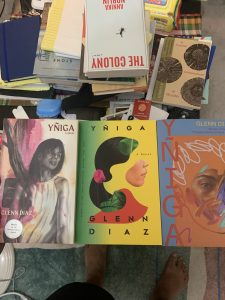
 It is less than a week before Yñiga comes out in the US. I tell myself it is not a big deal. The book is already out where it matters, already circulating among and being engaged by (or, at the v least, available to) the people for whom it was written, w/c more or less coincides w/ a group I clumsily imagine as Filipinos, but perhaps, less clumsily, also anyone to whom the kind of lifeworld and struggle in the novel are recognizable. I was, I remember, in a speeding trike on Katipunan, after class, exhausted, when I received photos of the launch of the Australian edition early this year. I will most likely be somewhere eating / drinking when it comes out in the US. I am struck, and in some way stabilized, by the thought of these things happening elsewhere, outside me, regardless of me, even if they involve a thing that is ostensibly mine, w/c I worked on, come to think of it, in what is now a faraway place and a far-off time. Also possible that this is, simply, a function of aging.
In a mesmerizing keynote that Gina A gave at a Zoom thing during the pandemic, she said she manages to write novels ‘precisely because I understand they are not me.’ While her curiosities give her books a charge, how she keeps a novel alive, how she ‘coaxes a book into being,’ are often ‘ways of listening, of thinking outside the box of yourself.’ Something about this sounded appealing to me (cf Aquarian sangfroid / chronic self-preservation). At the same time, we also know that things like our reading and history and maybe social structures fashion and steer the tools and techniques deployed by the novelist, the instincts and practices out of which a novel becomes possible. This was useful for instance while Yñiga was on submission to US and UK editors, a protracted, occasionally frustrating education in parsing the structural from the personal affront, in learning to resist the seductive, self-gratifying conflation of the two. The rejection is not about me. The indifference is not about me. It might be about my Filipino-ness or broader currents in publishing in the west, but it’s not about me per se. By the same token, the compliments and close calls and, eventually, acceptance are also not about me. There might be potential in the novel, but it needed to be collaboratively discovered, perhaps traceable to some affinity (aesthetic, political) with an editor’s, itself a result of a lifetime of reading, someone’s situatedness in countless vectors of experience and identity and so on.
I am entertained by the idea that my life, 40 years long, is possibly not about me. Something is wounded but also freed in the concession. I grew up carrying denial as an important modus, w/c recent crises have made untenable. ‘It is not about me’ recruits others in the act of meaning-making while also apportioning agency, causality. Like Gina, I find it a very sane strategy. That Yñiga seems to be (generally) less inviting than my first book, for instance, is not just about me. It is, in fact and by design, not the most welcoming or hospitable reading; the protagonist is intense, ungentle, opaque, (aka a normal Scorpio). The narration refuses, or at least regulates or rations, legibility; it pointedly eschews handholding—a weird, almost counter-intuitive exercise in empathy (as I write here) and born of a hyper-awareness that my first readers were not Filipinos (i.e., no translations, glossaries). It attempts to map a dizzying constellation of historical actors and intimate happenstance. Linear time is both existential suggestion and untenable nightmare. At one point, the narrative is surrendered to a cat.
It feels almost self-indulgent to think about an old work like this, as if it were new, when it should no longer be mine—not in the potentially flattening ‘every reader makes the book their own’ kind of way but in that it should be, by now, distant, or distant enough. I suspect that the worry is because the work-in-progress is plodding on, refusing to be coaxed, and the new editions appear to be distracting me from this tiresome fact. But even that is not about me. Or my doing alone. I blame precarity. Or my occasionally ridiculous screen time. Shows like Widow’s Bay. A couple of days ago I breached, finally, the 20,000-word mark, either a third or a quarter or a fifth of the way through, in addition to finishing a couple of short story drafts over the past couple of weeks amid the endless marking. Though short-lived, these exhilarations were mine, because inside them was the promise of the work’s continued fashioning, w/c means a future, w/c means a life. In this roundabout way I continue to learn from an old book, w/c is simultaneously a new one, whose newness became possible because of others. Tritely: in writing as in life.